

Weekly Market Review - 7 September 2026
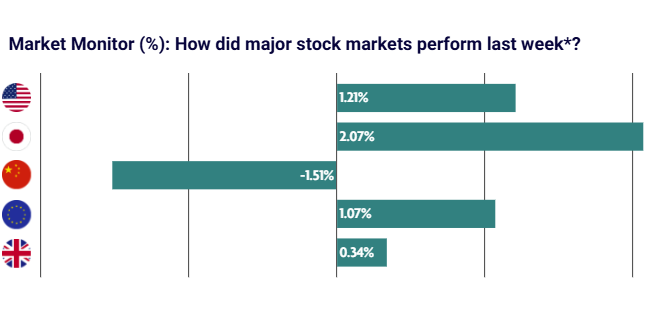
Global equities were mixed for the week as investors weighed renewed geopolitical tensions in the Middle East against better-than-expected economic data. US and UK equities proved more resilient, while Japanese equities lagged on expectations of a near-term increase to interest rates from the Bank of Japan.

US: Investors weigh strong economic data against rising geopolitical tensions
U.S. equity markets finished the week broadly unchanged, with the Nasdaq posting modest gains while the Dow Jones slipped slightly as investors weighed stronger economic data against rising geopolitical risks. Renewed hostilities between the U.S. and Iran pushed oil prices higher early in the week, boosting energy stocks and reigniting concerns that inflationary pressures could remain elevated. Treasury yields also moved higher, with the 10-year yield briefly approaching 4.8%, reflecting concerns that the Federal Reserve may need to keep policy restrictive for longer.
Sentiment improved midweek after comments from Fed Governor Christopher Waller suggested rates could remain on hold if inflation continues to moderate. However, a much stronger than expected August jobs report shifted expectations again, increasing speculation that further policy tightening may still be possible. The U.S. economy added 162,000 jobs during the month, significantly ahead of forecasts, while unemployment held steady at 4.1%. Economic activity remained resilient overall, with both manufacturing and services PMI surveys indicating continued expansion, although persistent input cost pressures highlighted ongoing inflation risks.
Japan: Japanese 10-year government bond yield hits highest level since 1996
Japanese equities weakened over the week as investors focused on rising bond yields and growing expectations of a near term Bank of Japan interest rate increase. The yield on the 10-year Japanese government bond briefly exceeded 3%, reaching its highest level since 1996 before easing later in the week. Expectations of tighter monetary policy contributed to a sharp strengthening of the yen, which added pressure to Japan's export-oriented companies.
Renewed tensions in the Middle East and higher oil prices also weighed on investor sentiment, exacerbating concerns around economic growth. Economic data showed continued weakness in consumer spending, with household expenditure falling more than expected in July. However, industrial production continued to expand, suggesting parts of the economy remain resilient despite ongoing challenges.
China: Equities pullback on weakness in technology and AI related stocks
Chinese markets delivered mixed performance, with mainland indices moving lower while Hong Kong equities edged higher over the week. Investor sentiment on the mainland was dampened by weakness in technology and AI related shares, which faced pressure from rising global bond yields and higher oil prices. Property stocks were also volatile after authorities announced stricter rules governing residential property presales, raising concerns about developer funding conditions. Economic data showed some signs of improvement, with the official manufacturing PMI moving closer to expansion territory and production levels strengthening.
Europe: Rising energy prices and bond yields weigh on European equities
European equities moved lower over the week, as investors reacted to higher energy prices and rising bond yields. Germany’s DAX closed 1.97% lower, France’s CAC 40 Index declined 1.46%, and Italy’s FTSE MIB fell 0.98%. Renewed tensions in the Middle East sparked concerns about oil and gas supply disruptions, pushing energy prices sharply higher and fuelling inflation worries. Government bond yields across the region rose as markets reconsidered the timing and extent of potential interest rate cuts.
Despite these headwinds, technology stocks provided some support, benefiting from continued enthusiasm surrounding artificial intelligence. Economic data painted a mixed picture, with eurozone retail sales suffering their sharpest monthly decline since May 2025, highlighting ongoing pressure on consumers. Producer prices also rose more than expected, largely driven by higher energy costs, reinforcing concerns that inflation could remain sticky.
UK: Energy and defensive sector exposure sees UK equities more resilient
The UK market proved relatively resilient, with the FTSE 100 ending the week broadly unchanged despite weakness elsewhere in Europe. Investor sentiment was affected by reports that the government was considering additional fiscal measures, including potential windfall taxes on banks and energy companies. Higher gilt yields also created a more challenging environment for rate sensitive sectors and domestically focused stocks. On the economic front, new car registrations rose 13.7% year on year in August, marking a ninth consecutive month of growth and suggesting consumer demand remains relatively healthy. While macroeconomic uncertainties persist, the UK market benefited from its exposure to energy and defensive sectors.

What’s Important Next: 7 September to 11 September 2026
The Number That Could Break the Fed's Back
US CPI inflation for August is released on Friday, and it may well decide whether the Federal Reserve hikes rates at its September meeting.
Why it’s important
Rarely does a single data print carry this much weight. The Fed has kept rates at 3.50% to 3.75% since July, but pressure for further tightening is building. Three policymakers voted against the committee’s majority decision at the last meeting. Cleveland Fed President Beth Hammack has repeatedly argued for a tougher stance, and Chair Kevin Warsh used his Jackson Hole speech to emphasise that inflation remains the Fed's "predominant focus". Then came Friday's August payrolls report: 162,000 jobs added versus expectations of 65,000, alongside upward revisions to previous months. The labour market, it seems, has yet to get the message about slowing down.
Markets are now pricing around 0.15% to 0.16% of additional rate increases at the September meeting, suggesting a rate hike is firmly on the table, though not fully priced in. The 2-year Treasury yield, which reflects expectations for future interest rates, has been hovering around 4.40%, its highest level since early 2025. Fed Governor Christopher Waller, widely viewed as a key swing vote, has said the upcoming CPI release will be "heavily influential" in determining his decision.
Consensus forecasts headline inflation at 3.4% year on year, unchanged from July, while core inflation, which excludes the more volatile food and energy categories, is expected to ease slightly to 2.4% from 2.5%.
Wednesday's Producer Price Index release will provide an important preview.
The stakes are clear. A hotter than expected inflation reading, such as headline CPI above 3.5% or core remaining above 2.5%, would likely cement the case for a September rate hike, pushing two-year Treasury yields beyond 4.50%, strengthening the dollar, and putting pressure on equity markets. Conversely, a softer print, with core inflation drifting towards 2.3% or below, would give the Fed scope to keep interest rates on hold, supporting bond markets and offering risk assets some much needed relief.
The bottom line: this is the most consequential meeting in months, and the Fed has essentially outsourced its September decision to the Bureau of Labor Statistics.
The ECB's Last Hurrah, or Just the Beginning?
The European Central Bank meets on 9 and 10 September in Berlin, with the rate decision and President Christine Lagarde's press conference due on Thursday. Markets are expecting the ECB to hike rates by 0.25% to 2.50%. However, the real drama is what Lagarde signals about what comes next.
Why it’s important
The ECB has become the G7's resident hawk, which is a sentence that would have seemed utterly absurd just a few years ago when the institution was paying banks to borrow money. Yet here we are. The deposit rate currently sits at 2.25%, and a hike to 2.50% on Thursday is so well telegraphed that Bundesbank President Joachim Nagel noted markets have "a rather good understanding" of what is coming, which in central bank speak means it is basically done. The real question, and the one that will move markets, is whether this is the final hike or merely a pitstop.
Here lies the fascinating divide. Bloomberg's survey of economists suggests Thursday's move will be the last, with the deposit rate expected to remain at 2.50% through 2027. Markets, however, are telling a very different story, pricing in roughly three additional rate hikes by mid-2027. It is a gap in expectations that is both striking and potentially significant. The backdrop helps explain the discrepancy. Eurozone growth has proved more resilient than many anticipated, while energy-driven inflation remains a concern. Renewed tensions involving Iran continue to support oil and gas prices, complicating the inflation outlook and keeping pressure on policymakers.
If Christine Lagarde adopts a hawkish tone at the press conference, the euro could strengthen meaningfully, Bund yields could move higher, and European equities, particularly rate-sensitive sectors, may come under pressure. Conversely, if she signals that rates have reached their peak and the Governing Council is shifting towards a data-dependent pause, investors could see a relief rally in European bonds alongside a weaker euro.
The bottom line: the hike itself is the boring part. Watch every syllable of that press conference.
From Defence to Offence: Has Iran Just Changed the Rules of the Game?
Over the weekend, Iran fired ballistic missiles at two US Navy warships, including an aircraft carrier, in the Strait of Hormuz, prompting the US to strike three Iranian oil tankers in retaliation, with tit-for-tat exchanges continuing into Sunday.
Why it’s important
Let's be clear about what just happened, because the language of "escalation" risks making this sound routine when it is anything but. Iran did not mine a shipping lane or harass a commercial vessel. It launched ballistic missiles at a U.S. aircraft carrier. That is a fundamentally different act, crossing a threshold that even some of the Pentagon's most hawkish planners had long viewed as a red line. Markets will spend the week trying to assess what this means for the conflict and its broader consequences.
The context matters. The conflict has been grinding on since early 2026, with the U.S. enforcing a naval blockade of Iranian ports and carrying out periodic strikes on Iranian infrastructure. ANZ Research noted as recently as Friday that the geopolitical stalemate is likely to keep Persian Gulf oil flows constrained into 2027, with the conflict reportedly displacing more than 1.9 billion barrels of cumulative output versus February levels. Brent crude has already surged nearly 17% over the past month, reaching $96.28 per barrel on Sunday, just below the recent high of $97.62 recorded on 3 September. The $100 mark is now firmly within sight.
The week ahead presents three possible paths. First, a further Iranian escalation, perhaps targeting a manned vessel or the infrastructure of a Gulf ally. This would likely push Brent above $100, trigger a flight to safe havens such as Treasuries, gold and the U.S. dollar, and weigh heavily on global equities, particularly sectors exposed to transport costs or consumer spending. Second, signs of de-escalation, potentially through Qatari or Omani back channels, would provide relief for risk assets and help contain the spike in oil prices, although expectations for diplomacy remain low given that no negotiations are currently scheduled. Third, and perhaps most likely, is a continuation of the current tit-for-tat pattern, keeping oil prices elevated, supporting defence stocks and leaving broader markets on edge. Comments from the U.S. Energy Secretary on Sunday that Navy escorts through the Strait of Hormuz are "essential" and "won't end anytime soon" do not sound like the language of a side preparing to step back.
Bottom line: oil at $100 is no longer a tail risk, it is the base case if Iran fires again, and the week's geopolitical news flow may matter more than any data release on the calendar.


Comments