

Weekly Market Review - 5 October 2026
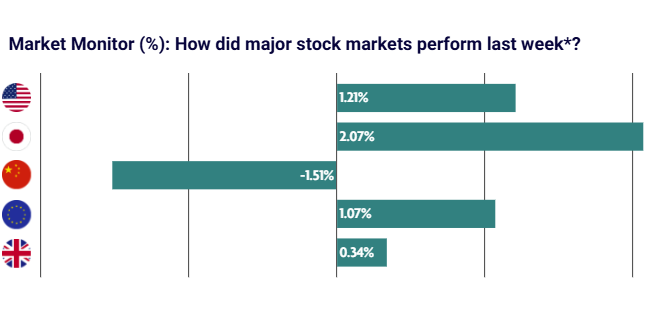
Equity markets were mixed as the higher-for-longer interest rate narrative continues to influence investor sentiment. Japanese equities were the standout performer, while UK, European and Chinese markets weakened.

US: economic momentum remained intact as softer payroll growth reinforced expectations for unchanged rates
U.S. equities delivered mixed performance over the week, with the Nasdaq leading the way but unfortunately offset by weakness in the broader market as investors balanced softer labour market data against elevated bond yields and geopolitical uncertainty. Attention centred on this month’s non-farm payroll report, which showed the economy added just 29,000 jobs, while unemployment edged up to 4.2%, reinforcing expectations that the Federal Reserve may continue to hold rates where they are.
Treasury yields remained volatile, with long dated yields touching multi-decade highs before easing later in the week, providing some support to growth stocks. Inflation data was broadly stable, with headline and core Personal Consumption Expenditure data unchanged at 3.4% and 3.0% year-on-year respectively, while Q2 GDP growth was revised higher to an annualised 2.2%, highlighting continued economic resilience. Manufacturing activity remained in expansionary territory, supported by stronger new orders and employment, although a sharp rise in input costs suggested inflationary pressures remain present beneath the surface.
Japan: Semiconductor names lead Japanese equities higher
Japan extended a third week of gains with the Nikkei 225 advancing 2.85%, which was predominantly semiconductor names. The Bank of Japan's latest meeting highlighted differing views on the pace of future rate hikes, although policymakers broadly maintained a tightening bias as inflation remains above target. Inflation accelerated sharply during September, with core consumer prices rising faster than expected, reinforcing the case for additional policy tightening.
The 10-year Japanese government bond yield remained elevated near 3.1%. Economic data was mixed, with business sentiment remaining resilient according to the Tankan survey, although weaker-than-expected industrial production pointed to some softness in underlying economic activity.
China: Equities retreated as stimulus optimism faded and concerns over trade restrictions intensified
Chinese equities weakened over the week, with mainland and Hong Kong markets coming under pressure as investors weighed disappointing policy support measures against a backdrop of higher U.S. bond yields and geopolitical uncertainty. Tech shares led declines, with semiconductor and optical equipment companies affected by concerns over intensifying competition and the potential for additional U.S. restrictions, while Hong Kong-listed financial and technology stocks also retreated sharply. Although Chinese authorities unveiled their most significant stimulus package since 2024, including measures to support housing demand, bank lending and investment, investors viewed the package as insufficient to address deeper structural challenges facing the economy.
Europe: Eurozone pressures continue as rising yields and fiscal concerns overshadowed improving growth
European equities declined with the STOXX Europe 50 down 1% as investors grappled with elevated bond yields, higher energy prices and stronger than expected inflation data. Major markets weakened, with France and Italy underperforming, while Germany also posted modest losses. Inflation continued to accelerate across the eurozone, reinforcing expectations that the ECB may need to maintain restrictive monetary policy for longer.
Rising sovereign bond yields added pressure to rate sensitive sectors, while concerns over fiscal sustainability also resurfaced, particularly in France following the government's latest budget proposals. Although improving growth expectations provided some support, persistent inflationary pressures and higher borrowing costs continued to weigh on market confidence and the outlook for European equities.
UK: Rising Gilt yields and oil prices weigh on UK Equities
UK equities weakened over the week, with the FTSE 100 falling 2.2% as higher gilt yields, elevated oil prices and concerns over the outlook for interest rates weighed on investor sentiment. Energy markets remained a key focus, with Brent crude briefly rising above US$108 per barrel, fuelling inflation concerns and contributing to higher borrowing costs across the economy.
Revised economic data showed that UK GDP grew by 0.5% in Q2, slightly ahead of previous estimates, highlighting continued resilience in the services sector. Manufacturing data provided a modest bright spot, with the UK Manufacturing PMI improving to 51.9 in September, indicating continued expansion in industrial activity despite a more difficult environment for businesses and consumers.

What's Important Next: 5 October to 9 October 2026
US Fed Meeting Minutes Released
On Wednesday 7 October, the minutes from the latest Federal Open Market Committee meeting will be released.
Why it’s important
At its September meeting, the Federal Reserve raised interest rates by 25 basis points (0.25%), marking its first rate increase since July 2023.
This was significant for two reasons.
Firstly, it demonstrated that the Fed remains concerned about inflation while also signalling confidence that the US economy is strong enough to withstand higher interest rates. The minutes should therefore provide valuable insight into policymakers’ thinking, including whether further rate increases may be required, the likely pace of any future moves, and the relative importance being placed on different economic indicators. Subsequent economic data has generally supported the view that the US economy remains resilient, while inflation remains above the Fed’s target level. Investors will therefore be looking closely for clues about the future direction of US interest rates.
Secondly, with bond yields having risen sharply in recent months, the Fed’s credibility is under increased scrutiny. The language used in the minutes will be analysed closely for evidence of a disciplined and consistent policy approach. The Federal Reserve has so far maintained its focus on its inflation and employment objectives despite political pressure for lower interest rates, which many investors view as supporting its independence and credibility.
EU and China Trade Talks
On Thursday, EU Trade Commissioner Maroš Šefčovič is expected to visit China for discussions with Wang Wentao, China’s Commerce Minister, with talks continuing through to Friday.
Why it’s important
As the saying goes, “trade makes the world go round.” At a time when global trade tensions remain elevated and US tariffs continue to reshape trading relationships, the ability of two of the world’s largest economic powers to maintain constructive trade relations is important.
One of the key issues will be European concerns over rising imports of Chinese goods, particularly electric vehicles and other strategically important manufactured products, which have intensified competition for European businesses. Any indication of further measures to address trade imbalances or manage imports into Europe could have significant implications for both industries and investors.
The discussions are also expected to cover broader issues including AI, given China’s growing strength in this area and Europe’s desire to remain competitive. From a market perspective, investors will be watching closely for signs of improved cooperation between the two sides.
Any developments that support stronger trade flows, improved corporate profitability and better long-term economic growth would be welcomed by markets. In addition, Germany’s recent loosening of its "debt brake", which allows for greater public investment and fiscal spending, could strengthen Europe’s negotiating position by providing additional economic support and boosting purchasing power within the bloc.
This update reflects our view at the time of writing and is subject to change. The document is for informational purposes only and is not investment advice. Omnis Investments is unable to provide investment advice. Every effort is made to ensure the accuracy of the information, but no assurance or warranties are given. Past performance should not be considered as a guide to future performance.


Comments