

Weekly Market Review - 6 July 2026
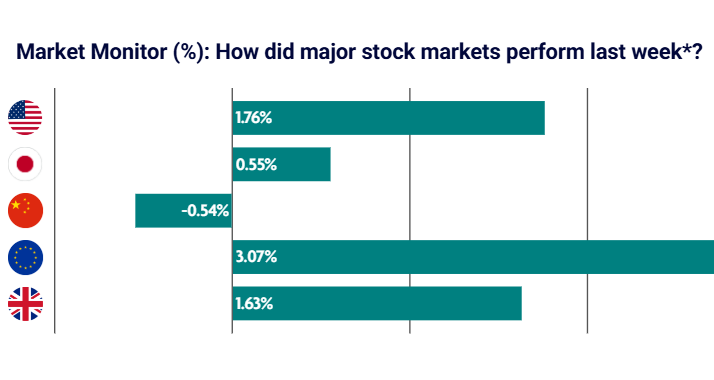
Global equities were broadly higher for the week following a softer week last week. European equities performed best, supported by better-than-expected inflation data. Chinese equities lagged amid softness in AI and Tech stocks.
US: Labour market shows signs of weakness
US equities were mixed over the holiday shortened week, with the S&P 500, Nasdaq and Dow Jones all advancing, while smaller companies lagged. Communication services, financials and consumer discretionary sectors led gains, while real estate, utilities and energy were weaker. Economic data pointed to a cooling labour market. Non-farm payrolls rose by 57,000 in June, well below expectations, while previous months were revised lower. Although the unemployment rate edged down to 4.2%, softer hiring data from both ADP and the official payroll report reinforced expectations that the Federal Reserve may have less reason to raise rates. Consumer confidence remained subdued, while manufacturing activity continued to expand but at a slower pace. Treasury yields moved higher over the week, weighing on bond returns, although investment grade corporate bonds slightly outperformed government bonds.
Japan: Manufacturing confidence reaches its strongest level since 2018
Japanese equity markets rallied for the week. Profit taking occurred in technology and semiconductor stocks following a strong artificial intelligence driven rally, while financials and cyclical sectors benefited from rising bond yields and improving business sentiment. The Bank of Japan's Tankan survey showed manufacturing confidence improving for a fifth consecutive quarter, reaching its strongest level since 2018. Industrial production rose modestly but missed expectations. The yen remained volatile, weakening to its lowest level in almost 40 years against the US dollar before rebounding on speculation that authorities could intervene to support the currency.
China: Stocks ease as AI and Tech companies come under pressure
Chinese equities were mixed, with mainland markets broadly weaker while Hong Kong shares posted gains. Investor sentiment was supported by stronger than expected manufacturing data and improved liquidity conditions, although technology and artificial intelligence related shares came under pressure. June Purchasing Manager Index (PMI) data showed manufacturing activity returning to expansion, with both production and new orders improving. The People's Bank of China also introduced new overnight liquidity operations to improve short term funding conditions. While supportive for market sentiment, investors viewed the move as a refinement of the policy framework rather than the start of a broad monetary easing cycle.
Europe: Soft inflation data reduces pressure on the ECB to tighten further
European equities moved higher, supported by easing concerns around inflation and the potential economic fallout from Middle East tensions. Among major stock indices, Germany’s DAX finished 3.69% higher, France’s CAC 40 Index rose 1.07%, and Italy’s FTSE MIB gained 2.27%. Eurozone inflation fell to 2.8% in June, below expectations and down from 3.2% in May. The softer inflation reading reduced pressure on the European Central Bank to tighten policy further. Meanwhile, German retail sales surprised to the upside, highlighting some resilience in consumer spending, while unemployment across the euro area remained stable at 6.2%.
UK: Equities rise on improving global sentiment
UK equities also moved higher over the week, with the FTSE 100 benefiting from improving global sentiment. Economic data remained broadly supportive. Final figures confirmed that UK GDP grew by 0.6% in the first quarter of 2026. House price growth also accelerated in June, with Nationwide reporting annual growth of 2.2%, suggesting continued resilience in the housing market despite a challenging economic backdrop. Keir Starmer announced an extra £15bn for defence over the next four years, aiming to transform a military that has been “underfunded and unsuited to the threats we face”. The increase is expected to come at the expense of some road and energy projects that are important, but not “immediately vital”.

What's Important Next: 6 July to 10 July 2026
NATO Summit, Ankara, Turkey
On Tuesday, NATO leaders, including US President Donald Trump, will meet in Ankara.
Why it's important
NATO's collective defence commitment, often referred to as the "one for all, all for one" principle, has come under increased scrutiny in recent years. While Article 5 has never been formally tested in the current geopolitical environment, questions remain over how strongly the US would respond if called upon by an ally. Mixed messaging around support for Ukraine has also led some European nations to reassess their reliance on US security guarantees.
This shift has accelerated efforts across Europe to strengthen domestic defence capabilities and increase military spending. Germany in particular has undergone a significant change in approach, committing to higher defence expenditure and adopting a more flexible interpretation of its fiscal rules. These developments have driven considerable volatility in European defence stocks and have wider implications for government borrowing and fiscal policy. Markets will be watching closely for any signals on the future direction of NATO, the level of European defence spending required, and the extent to which countries may need to take greater responsibility for their own security. Any change in sentiment could have implications for both European equity and bond markets.
US Federal Reserve Meeting Minutes
On Wednesday, the Federal Reserve will release the minutes from its first policy meeting under new Chair Kevin Warsh.
Why it's important
Chair Warsh has already introduced a noticeably different approach to Fed communications. At his first meeting, the Fed removed its traditional "dot plot", which previously showed policymakers' expectations for the future path of interest rates. The official policy statement was also significantly shortened and the accompanying press conference provided little indication of the likely direction of future policy.
Speaking at the ECB Forum in Sintra last week, Warsh again avoided offering forward guidance, maintaining a cautious and measured stance on the outlook for interest rates. As a result, the minutes will be closely scrutinised for clues about his thinking and, more importantly, whether the committee leans towards a more hawkish or dovish stance. So far, markets have generally interpreted Warsh as hawkish, suggesting a greater willingness to keep rates higher or raise them if inflation risks persist.
Any indication that this view is changing, or further confirmation of it, could have a meaningful impact on US interest rate expectations, bond yields and equity market performance.
This update reflects Omnis’ view at the time of writing and is subject to change. The document is for informational purposes only and is not investment advice. We recommend you discuss any investment decisions with your financial adviser. Omnis is unable to provide investment advice. Every effort is made to ensure the accuracy of the information, but no assurance or warranties are given. Past performance should not be considered as a guide to future performance.


Comments