

Weekly Market Review - 21 September 2026
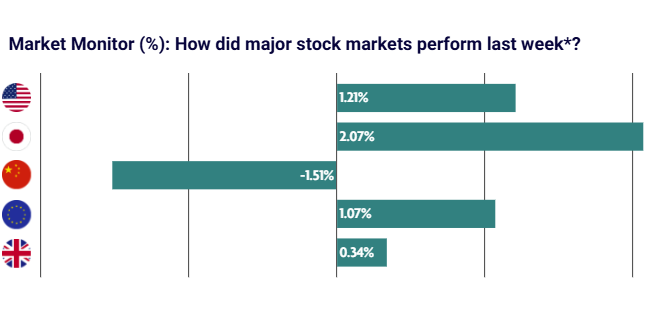
Global equities were mixed as investors weighed a raft of central bank decisions and renewed geopolitical tensions in the Middle East. Japanese equities were the standout performer, as a weakening Japanese yen provided support for their export-oriented industries.

US: The Federal Reserve raises interest rates for the first time since 2023
U.S. markets finished the week mixed as investors navigated the Federal Reserve's first interest rate increase since 2023, renewed Middle East tensions and ongoing developments within the AI sector. The Fed raised rates by 0.25% to 3.75%-4.00% and signalled the possibility of one further increase before the end of 2026, while Treasury yields remained elevated after the 10-year yield briefly moved above 5%. Oil prices surged early in the week following attacks on Saudi energy infrastructure, stoking fresh inflation concerns, although prices later eased as fears of prolonged supply disruption diminished. AI-related stocks initially fell after prominent industry leaders called for a slower pace of AI development to address safety risks, but sentiment recovered quickly following supportive comments from major technology executives, helping the Nasdaq outperform broader markets. In fixed income markets, investment grade corporate bonds proved relatively resilient as strong demand for new issuance supported returns, while high yield bonds came under pressure from rising yields and inflation concerns.
Japan: The Bank of Japan lifts interest rates to their highest level in more than three decades
Japanese equities advanced over the week, supported by a recovery in AI-related stocks, a weaker yen and a widely anticipated interest rate increase from the Bank of Japan. The central bank raised rates by 0.25% to 1.25%, its highest level since 1995, although the decision was not unanimous and policymakers offered little guidance on the pace of future tightening. The yen weakened sharply against the U.S. dollar, providing support for Japan's export-oriented companies, while easing concerns around oil supply disruptions also supported market sentiment. Economic data was mixed, with inflation easing slightly but imports rising significantly due to higher energy costs, while softer machinery orders suggested some moderation in business investment.
China: Equities broadly flat as Tech sector rebound buoys investor sentiment
Chinese markets delivered mixed performance, with mainland equities broadly outperforming Hong Kong following a technology-led rebound late in the week. Economic data highlighted continued divergence within the economy, as industrial production strengthened while consumer demand, property activity and credit growth remained weak. Retail sales growth slowed further, real estate investment continued to contract sharply and household borrowing declined for a sixth consecutive month, underlining ongoing domestic demand challenges. However, semiconductor and AI-related companies rebounded strongly as technology shares recovered across the region, helping support market sentiment despite the weaker macroeconomic backdrop.
Europe: Higher oil and gas prices fuel inflation concerns
European equities declined modestly over the week as higher oil and natural gas prices fuelled inflation concerns and pushed bond yields higher. Escalating tensions in the Middle East weighed on sentiment early in the week, particularly across industrial and consumer-focused sectors, while weakness in AI-related technology stocks added further pressure. Inflation in the eurozone rose to 3.2% in August from 2.9% in July, driven largely by energy costs, although core inflation remained more contained. Germany's latest economic sentiment survey pointed to some improvement in current conditions, but confidence in the recovery remains cautious. Markets stabilised towards the end of the week as oil prices retreated and investors digested central bank decisions across major developed economies.
UK: Interest rates kept unchanged at 3.75%, despite three policymakers favouring an immediate increase
UK equities were broadly flat for the week. The Bank of England kept interest rates unchanged at 3.75%, although the decision was accompanied by a three-way split vote in favour of further tightening, highlighting ongoing concerns around inflation. UK inflation rose to 3.1% in August from 2.9%, largely due to higher fuel prices, while unemployment remained broadly stable at 4.9%, slightly better than expected. Policymakers indicated that further rate increases could still be required if higher energy costs become embedded in broader inflation trends. Against this backdrop, the FTSE 100 finished the week broadly flat as gains in energy-related companies helped offset wider market uncertainty.

What’s Important Next: 21 September to 25 September 2026
"Events, dear boy, events"
On Tuesday, the United Nations General Assembly begins its 81st annual General Debate, bringing together world leaders for a series of speeches, discussions and high-level diplomatic meetings.
Why it’s important
Former UK Prime Minister Harold Macmillan is said to have used the phrase, "Events, dear boy, events", when asked what most often derails a government's plans. It is a timely reminder that, regardless of forecasts, expectations and carefully laid strategies, unexpected events often have the greatest influence on political and market outcomes. Normally, the UN meetings are observed from the corner of the eye, but this time it is different.
First, over the weekend Trump announced his deal for Greenland. It certainly was not an annexation, but at the UN General Assembly there will likely be more clarity on what has been agreed and the consequences. Second, there is expected to be a meeting between the US, Saudi Arabia, the UAE, Qatar, Bahrain, Kuwait and Iran. With global bond markets now hostage to the inflationary impact of the Gulf war, any sense of a credible off ramp would be very significant.
This matters because elevated bond yields are beginning to weigh on both equity valuations and borrowing costs. As a result, any indication that these pressures are either easing or intensifying could have important implications for both bond and equity markets in the weeks ahead.
Trump and Xi meet
On Thursday, Chinese President Xi Jinping visits the US.
Why it’s important
The US and China are the world’s two economic and military superpowers, so a meeting between their leaders at any time is significant. Right now, there are additional areas of focus. First, there is the tariff war, where President Trump has arguably met his match in terms of his ability to use tariffs as leverage. Second, there is the AI race. Only last week, President Trump suggested that the bigger challenge is staying ahead in AI development, rather than worrying about the technology getting out of control.
The first issue is important in terms of trade, US deficits, and US hegemony. The second issue is arguably even more important for investors in the short term, as the huge AI capital expenditure in the US has been a key driver of extraordinary stock market performance and economic growth. Any headlines, or any sense of direction on either of these issues, could move markets in the short term. Indeed, if policymakers were to slow AI investment because of concerns that increasingly powerful AI systems could become difficult to control, a scenario often likened to Terminator’s Skynet, the impact on US technology stocks could be profound.
This update reflects our view at the time of writing and is subject to change. The document is for informational purposes only and is not investment advice. Omnis Investments is unable to provide investment advice. Every effort is made to ensure the accuracy of the information, but no assurance or warranties are given. Past performance should not be considered as a guide to future performance.


Comments