

Weekly Market Review – 20 July 2026
Updated: Jul 29
Global equities retreated as a sharp sell-off in technology and AI-related stocks weighed on sentiment, while geopolitical tensions and higher oil prices added to market uncertainty.

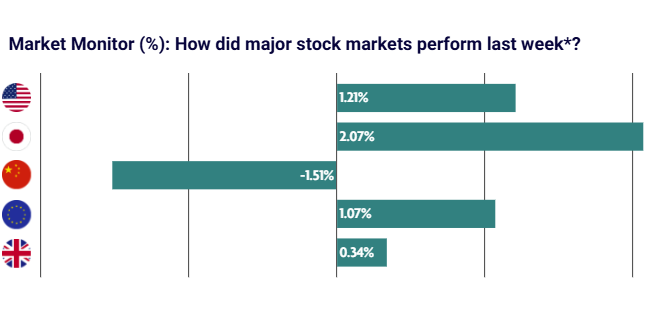
US: Equities decline as Tech & AI related stocks lead markets Lower
U.S. equities ended the week lower, with the Nasdaq and S&P 500 leading declines as weakness in large-cap technology and AI-related stocks outweighed generally strong start-of-season bank earnings. Investor sentiment was supported by softer than expected inflation data, as both CPI and PPI came in below forecasts, reducing expectations for a near term Federal Reserve rate hike and driving Treasury yields lower. Economic data continued to highlight resilience in consumer spending and the labour market, with retail sales and jobless claims remaining supportive, although housing activity stayed under pressure amid elevated mortgage rates and affordability challenges. In fixed income markets, U.S. Treasuries posted gains on cooling inflation and lower rate expectations, while investment-grade and high-yield corporate bonds also advanced. Meanwhile, the energy sector outperformed as oil prices rose on heightened geopolitical tensions between the U.S. and Iran.
Japan: AI valuation concerns drive market declines
Japanese equities posted significant declines over the week, with the Nikkei 225 and TOPIX falling amid weakness in technology and AI-related stocks, as investors questioned whether elevated valuations in the sector can be sustained. Risk sentiment was further dampened by escalating tensions in the Middle East and higher oil prices, which pressured the yen due to Japan’s reliance on energy imports. Japanese government bond yields moved lower as concerns about potential government influence over Bank of Japan policy eased following assurances that the central bank’s independence would be respected. Economic data pointed to softer business investment, with core machinery orders falling more than expected, while business sentiment among manufacturers remained stable on solid semiconductor demand, though confidence among nonmanufacturers weakened due to rising costs and geopolitical uncertainty.
China: Growth begins to slow as technology sell off weighs on equities
Chinese equities were mixed during a volatile week, with mainland markets declining sharply as AI, semiconductor, and memory-chip stocks sold off amid concerns over elevated valuations and intensifying competition in the sector. In contrast, Hong Kong equities advanced, supported by mainland inflows and strength in internet, automobile, healthcare, and selected property stocks. Economic data pointed to a moderation in growth, with second-quarter GDP slowing to 4.3%, although stronger industrial production, retail sales, and a surge in exports provided some support. However, weak fixed-asset investment, subdued domestic demand, and ongoing weakness in the property sector underscored the uneven nature of the recovery.
Europe: Cooling price pressure contrast with slowing activity
European equities were broadly flat over the week, with the STOXX Europe 50 little changed as investor sentiment was weighed by weakness in global technology stocks, renewed Middle East tensions, and higher oil prices. Germany and Italy posted losses, while France was largely unchanged. Economic data showed eurozone inflation easing to 2.8%, moving closer to the European Central Bank’s target, although industrial production unexpectedly declined, reflecting softer manufacturing activity. In Germany, wholesale price growth remained elevated despite moderating from the previous month. Meanwhile, Ireland’s economic data were mixed, with a narrower trade surplus, weaker construction activity, and continued strength in residential property prices, highlighting uneven growth across the region.
UK: Market gains despite weak industrial data and geopolitical uncertainty
In the UK market outperformed its European peers over the week, with the FTSE 100 rising 0.98%, benefiting from its relatively low exposure to the technology sector amid a global tech sell-off. Investors navigated a backdrop of corporate earnings releases, renewed Middle East tensions, and higher oil prices. UK economic data showed modest improvement, with GDP returning to growth in May, expanding 0.1% month-on-month after a slight contraction in April. However, industrial production disappointed, falling 0.5% over the month, driven largely by weaker mining and quarrying output. On the political front, Andy Burnham was confirmed as leader of the Labour Party and is set to become Prime Minister, providing a new focus for investors assessing the UK's economic and policy outlook.
What’s Important Next: 20 July to 24 July 2026
In the UK, another new Prime Minster is sworn in
On Monday Andy Burnham is sworn in as the latest UK new Prime Minister.
Why it’s important
“Policy…Policy, wherefore art thou”? Burnham’s rise to the pinnacle of power in the UK has been unique in two ways. One is the speed, frankly incredible and secondly just as “incredible / bizarre / worrying” is that it has occurred without any sense of his actual policies. It is this second matter that really matters.
The UK Weekend press was full of concerns regarding nationalisation and the return of the UK to the 1970s and with-it economic illiteracy. Whilst perhaps these are overly bombastic headlines, these are real issues that we have no idea about. Who will be his chancellor, and the broader cabinet, and what he will do fiscally? As these questions are answered and with them the implications - the impact on gilts and UK equites could be profound.
Earnings for the New Economy
On Wednesday earnings from Alphabet (Google) and Tesla are released.
Why it’s important
Mag 7 / Tech has been a key positive market mover over the last few years. Its most recent driver has been AI, where the likes of Google have spent incredible amounts of money to ensure they have the best AI product / tools.
Many have questioned the pay back, pointing out the similarities to the Railways where the reward for the investments took longer than expected, and that meant the initial investors lost out and lost their money. Also, there is much rebranding / reinventing going on. Telsa was once an Electric Vehicle company, it is now a Robot one, or even just more AI bandwidth for SpaceX. The more cynical might argue “chairs on the Titanic”, whilst believers have the parry “these companies are still making loads of money”. Hence the earning numbers will be closely watched for comforting reinsurance that the earnings are still there and predicted to be there in the future.
News late last week that a Chinese AI start up called Moonshot has new AI model Kimi K3 that rivals the strongest offering of OpenAI and Anthropic for way lower cost, reinforced concerns that US Hyperscalers’ huge investments will not pay back. For the US Stock market that was already looking overpriced and quite frankly a little wobbly at the end of last week, these numbers matter.


Comments