

Weekly Market Review - 17 August 2026
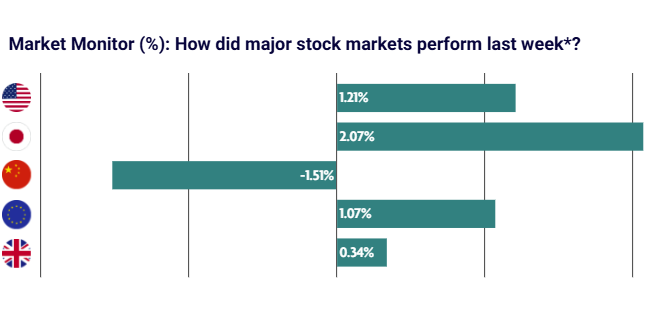
Markets were mixed last week as softer US inflation and strong gains in Japan helped support sentiment. However, weaker consumer data, higher-for-longer rate expectations, geopolitical uncertainty and continued growth concerns in China, kept investors cautious.

US: Softer inflation print helps reduce fed hike expectations as consumer spending weakens
U.S. markets ended the week mixed as investors weighed easing inflation and reduced expectations of a near-term Federal Reserve rate hike against rising oil prices, geopolitical tensions in the Strait of Hormuz, and weaker consumer data. While the Russell 2000 and S&P MidCap 400 gained over 1%, the S&P 500 posted modest gains while the Dow finished lower.
July’s inflation data came in as expected and producer prices were softer than anticipated, lowering the likelihood of a September rate hike. However, retail sales unexpectedly fell 0.6% and consumer sentiment weakened, raising concerns about economic growth. Treasury yields were volatile, with shorter-term yields declining on easing rate expectations while longer-term yields remained elevated due to fiscal and supply concerns.
Japan: Equities rally on semiconductor strength and prospects of further monetary policy tightening
Japanese equities posted strong gains during the week, with the Nikkei 225 rising 4.74% and the TOPIX Index advancing 3.00%, supported by robust tech earnings, particularly from chip companies. Export oriented sectors also benefited from a weaker yen, while banking stocks gained on growing expectations that the Bank of Japan (BoJ) could raise interest rates in the near term. This speculation was reinforced by reports suggesting government support for further policy tightening as policymakers seek to address inflationary pressures linked to yen weakness and rising living costs.
Economic data showed producer inflation remained elevated, with corporate goods prices rising 7.2% year over year in July, while improving semiconductor demand boosted manufacturer confidence, reflected in a rise in the Reuters Tankan Index from +13 to +18. Meanwhile, the yield on Japan’s 10-year government bond increased to 2.87%, reflecting heightened expectations of additional BoJ rate hikes.
China: property market support and tech sector optimism help sentiment despite weaker economic data
Chinese equities were volatile and ended the week lower, with Hong Kong markets underperforming. The Shanghai Composite and CSI 300 posted modest declines, while the Hang Seng Index fell more sharply due to weakness in major internet stocks and mixed earnings results. Inflation data showed both consumer and producer price growth cooled in July as the impact of earlier oil price shocks faded, easing some inflationary pressures.
Meanwhile, Beijing introduced further measures to support the property market by relaxing homebuying restrictions for non-residents, which boosted real estate shares. Investor sentiment was also supported by plans to expand Hong Kong’s Hang Seng Tech Index to include more AI and robotics companies, reflecting growing interest in high-growth technology sectors.
Europe: Resilient economic data and corporate earnings support markets despite geopolitical uncertainty
European markets ended the week slightly lower, with investors balancing resilient economic data and generally solid corporate earnings against ongoing geopolitical uncertainty in the Middle East and concerns over energy markets. Germany’s DAX posted modest gains, while France’s CAC 40 and Italy’s FTSE MIB declined. Energy-related stocks benefited at times from higher oil prices, although gains were tempered as energy market volatility persisted.
Economic indicators remained broadly supportive, with eurozone investor confidence improving for a fourth consecutive month and returning to positive territory, suggesting continued economic resilience. At the country level, France is expected to see modest third-quarter growth, while Switzerland reported stronger-than-expected economic expansion. However, low water levels on the Rhine River began affecting industrial activity in Germany, posing an additional supply-side challenge for the region.
UK: Higher for longer rate expectations and rising bond yields weigh on equities despite resilient economic growth
The UK market underperformed during the week, with the FTSE 100 Index falling 1.39% as investors remained focused on inflation risks, fiscal policy, and the outlook for interest rates. The Bank of England remained in the spotlight after Chief Economist Huw Pill indicated that stronger-than-expected economic growth supports the case for keeping borrowing costs higher for longer to bring inflation back to target.
UK government bond yields also moved higher, with the 10-year gilt yield rising above 5%, reflecting concerns about persistent inflation, government borrowing needs, and the potential for future tax increases. Despite signs of economic resilience, investor sentiment remained cautious as markets assessed the implications of higher interest rates and ongoing geopolitical uncertainty.

What’s Important Next: 17 August to 21 August 2026
US Fed minutes could provide clues on the path of interest rates
On Wednesday, minutes from July’s meeting are released.
Why it’s important
US interest rates are starting to become a key focus for markets. Not only are investors focused on when and whether rates will be raised, but also on the impact the lack of “forward guidance” is having on longer-term interest rates.
Heavy investment in AI infrastructure has become an important driver of US economic activity and a key contributor to stock market performance. However, more recently Big Tech has turned to debt markets to finance data centre investment. As interest rates rise across the yield curve, so too does the cost of that borrowing, increasing funding pressures for businesses and adding to the US government’s already substantial debt servicing burden.
Any indication from the minutes that further rate hikes are coming could lead to a meaningful increase in borrowing costs across the economy. The US government’s interest burden is growing to a point where it is starting to undermine confidence in the country’s fiscal position. (Interest on the public debt continues to be a key driver of the nation's budget deficit. For the fiscal year to date, the tally is $1.17 trillion, a 15% increase. Source: Bloomberg
Developed market PMIs provide a health check on economic growth
Purchasing Managers Index (PMI) data for the Eurozone, Japan and US are all released this week.
Why it’s important
PMI data is a useful leading indicator of economic activity. Recent readings have generally remained above the 50 level that signals expansion, suggesting economies have remained resilient despite higher interest rates.
Markets expect a broadly steady picture rather than a significant improvement in the PMI numbers. However, as concerns over an AI-driven market correction fade, investors are likely to place greater emphasis on economic fundamentals. Any signs of weakening activity could reinforce concerns that higher borrowing costs are starting to weigh on growth.
With longer-term interest rates rising to multi-year highs in some parts of Europe on Friday, stock markets may become increasingly sensitive to the impact of interest rates on economic performance
Issued by Omnis Investments, which is authorised and regulated by the Financial Conduct Authority. This update reflects our view at the time of writing and is subject to change. The document is for informational purposes only and is not investment advice. Omnis investments is unable to provide investment advice. Every effort is made to ensure the accuracy of the information, but no assurance or warranties are given. Past performance should not be considered as a guide to future performance.


Comments