

Weekly Market Review - 14 September 2026
Global equities pulled back amid rising energy prices on the back of increased geopolitical tensions in the Middle East. Domestic economic signals largely took a backseat, as we saw Brent Crude oil prices climb towards US$110/barrel.

US: Rising energy prices weigh on US equities; however, Tech sector proves resilient
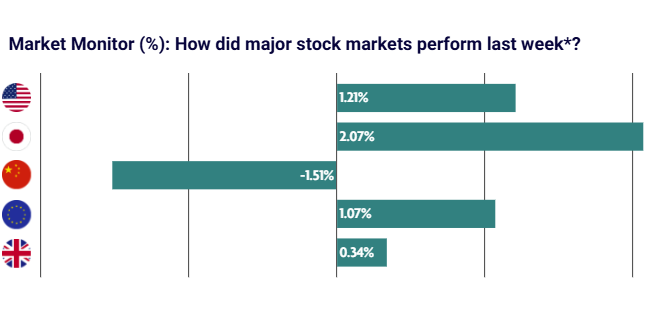
US equities ended the holiday-shortened week lower as escalating tensions in the Middle East pushed energy prices higher, reigniting inflation concerns and weighing on investor sentiment. Smaller companies were hit hardest, with the Russell 2000 and S&P MidCap 400 posting the largest declines, while the technology heavy Nasdaq proved comparatively resilient. Brent crude briefly climbed towards US$110 per barrel as concerns grew over potential disruption to regional energy supplies and shipping routes.
Rising oil prices, firm inflation data and heavy Treasury issuance helped push bond yields higher, with the 10-year Treasury yield approaching 5%. Inflation data reinforced expectations that the Federal Reserve may need to tighten policy further, with both producer and consumer price reports pointing to continued underlying price pressures. Markets responded by increasing the implied probability of a September rate rise, while labour market data continued to indicate a resilient economy. Consumer confidence weakened for a second consecutive month, however, as higher fuel costs and concerns around trade tensions weighed on household sentiment and inflation expectations.
Japan: The Japanese yen strengthened meaningfully against the US dollar
Japanese equities declined as investors weighed the impact of a stronger yen, rising bond yields and growing expectations of further monetary tightening by the Bank of Japan. Exporters and growth stocks came under pressure, although selected AI and semiconductor-related companies showed pockets of strength. The yield on 10-year Japanese government bonds rose as markets increasingly anticipated a Bank of Japan rate increase in September. The yen strengthened significantly against the US dollar, supported by expectations of tighter Japanese monetary policy and comments from U.S. officials. Economic data remained broadly encouraging, with second quarter GDP revised higher and real wages recording a seventh consecutive monthly increase.
China: Policymakers announced significant cash injections into several state-owned banks & insurers
Chinese equities fell over the week, with Hong Kong markets underperforming mainland indices as higher oil prices and rising US Treasury yields dampened risk appetite. Technology stocks remained volatile, with competition within the AI sector and dilution concerns weighing on sentiment despite strong performances from selected new listings. Policymakers announced significant capital injections into several state-owned banks and insurers to strengthen financial system resilience and support economic activity. Export growth remained a key bright spot, driven by strong demand for technology related products linked to global AI investment. Inflation picked up modestly, largely reflecting higher energy and input costs rather than a broad based recovery in consumer demand, reinforcing the view of an uneven economic backdrop.
Europe: Rising geopolitical tensions in the Middle East weigh on markets
European equities moved lower as rising geopolitical tensions and disruption concerns in the Strait of Hormuz pushed both oil and natural gas prices sharply higher. Germany’s DAX closed 1.83% lower, while France’s CAC 40 Index declined 1.20% and Italy’s FTSE MIB gained 0.79%. Higher energy prices fuelled inflation fears across the region and contributed to rising government bond yields.
The European Central Bank raised interest rates by 0.25%, while also increasing its inflation forecasts, signalling that policy may need to remain restrictive for longer. ECB President Christine Lagarde highlighted ongoing upside risks to inflation alongside weaker growth prospects. Despite these challenges, Eurozone economic activity remained resilient, with second quarter GDP expanding by 0.6%. Markets were broadly weaker, with Germany and France posting declines, although Italy outperformed and finished the week higher.
UK: UK economy expands more than expected in July
The UK economy delivered stronger than expected performance, expanding by 0.4% in July compared with expectations for flat growth. The services sector was the primary driver of activity, while technology related industries also contributed positively to growth. Industrial production rose modestly and exceeded market expectations, suggesting some resilience in the manufacturing backdrop. Despite the encouraging data, investors remained focused on the impact of elevated energy prices and higher gilt yields. Rising borrowing costs continue to represent a challenge for consumers, businesses and government finances. Attention is also turning towards the Autumn Budget, where fiscal pressures may become an increasingly important consideration.

What’s Important Next: 14 September to 18 September 2026
Will Warsh Blink, or Will He Bring the Pain?
The Federal Reserve delivers its September rate decision on Wednesday, accompanied by updated economic projections and the dot plot.
Why it’s important
This is the most consequential Federal Reserve meeting in years. Kevin Warsh finds himself caught between his boss's very public preference for lower rates and a bond market that is screaming the opposite, with the 10-year Treasury yield finishing last week just shy of 5%. Markets are pricing roughly a 90% probability of a 25-basis point hike to an upper bound of 4.00%, with Goldman Sachs flipping to a hike call after Friday's hotter than expected core CPI print.
A lot of the market's focus will be on the Federal Reserve's updated interest rate projections. If policymakers signal that interest rates may need to remain higher for longer, investors could become more cautious, putting pressure on both bond and equity markets. However, if the Fed raises rates this month but suggests it may pause further increases, markets could view that positively as it would provide greater clarity on the outlook for monetary policy.
Perhaps the biggest surprise would be if the Fed leaves interest rates unchanged. While this could support risk assets in the short term, it may also raise questions about the Fed's commitment to bringing inflation back under control. Ultimately, attention will centre on the Fed's assessment of inflation, economic growth, and the future path of interest rates, which is likely to drive market sentiment in the weeks ahead.
Bazooka Time in Tokyo?
The Bank of Japan is expected to deliver a 0.25% rate hike at its policy meeting, with the decision due during Asian trading hours on Thursday.
Why it’s important
Japan is expected to raise interest rates again this week, continuing its gradual move away from the ultra-low interest rate policy that has been in place for many years. Rising energy prices and firmer inflation have strengthened the case for the Bank of Japan to tighten monetary policy further.
Higher Japanese interest rates have important implications for global markets, particularly for investors who have borrowed cheaply in Japan to invest elsewhere. Recent market volatility highlighted how quickly these positions can unwind when expectations for Japanese interest rates change. While the expected rate rise is unlikely to come as a surprise, investors will be paying close attention to what the Bank of Japan says about the pace of future increases and the outlook for inflation and economic growth.
The AI Industry's "We Need to Talk" Moment
Markets open Monday facing the fallout from Anthropic CEO Dario Amodei's Saturday blog post calling on the entire AI industry to slow frontier model development, a statement quickly endorsed by OpenAI's Sam Altman and Elon Musk.
Why it’s important
The debate around artificial intelligence regulation intensified over the weekend after Anthropic CEO Dario Amodei called for a coordinated slowdown in AI development to allow more time for safety measures. The proposal received support from several prominent technology leaders, including OpenAI's Sam Altman and Elon Musk.
However, the idea also attracted significant opposition. President Donald Trump argued that the U.S. should not risk losing its technological lead to China, while Chinese state media criticised the proposal for very different reasons.
The contrasting reactions highlight the growing tension between advancing AI capabilities as quickly as possible and ensuring adequate safeguards are in place. As AI becomes increasingly important to economic growth and national competitiveness, the debate over speed versus safety is likely to remain a key theme for investors and policymakers alike.
The bottom line has been answered in real time: markets have decided, at least for this morning, that Amodei is more of a prophet than spin doctor, and the AI complex is paying the price before New York has even opened for business.
This update reflects our view at the time of writing and is subject to change. The document is for informational purposes only and is not investment advice. Omnis Investments is unable to provide investment advice. Every effort is made to ensure the accuracy of the information, but no assurance or warranties are given. Past performance should not be considered as a guide to future performance.


Comments