

Weekly Market Review - 12 October 2026
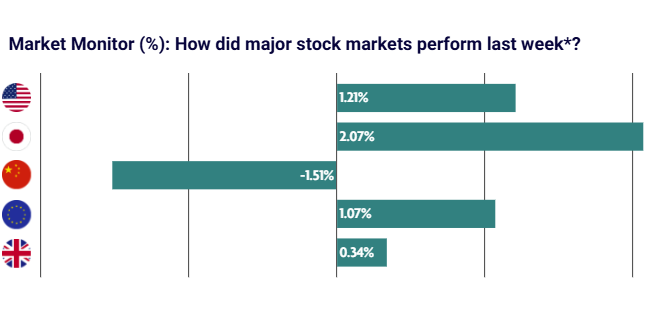
Equity markets were mixed as investors weighed resilient economic growth against persistent inflation and geopolitical risks. US and Japanese equities led gains, while European and Chinese markets were more subdued.

US: Defence sector leads as markets navigate inflation and geopolitical risks
US equities delivered a mixed performance over the week, with the S&P 500 up 1.15%, as we saw strength in defensive, consumer staples, utilities and energy sectors. While tech and industrial names lagged amid continued volatility surrounding AI names. Investor sentiment was shaped by escalating geopolitical tensions in the Middle East, which drove significant fluctuations in oil prices, and by ongoing uncertainty over the path of US monetary policy.
Fed minutes reinforced expectations that further interest rate increases remain possible as inflationary pressures persist, although policymakers maintained a data dependent stance regarding the timing of any future action. Economic indicators pointed to resilient activity within the services sector but also highlighted ongoing inflation concerns, with both business and consumer surveys showing elevated inflation expectations. Bond markets were similarly volatile, as Treasury yields briefly reached multi-decade highs before retracing.
Japan: Semiconductor names lead Japanese equities higher despite macro headwinds
Japanese equities finished the week higher, with the Nikkei 225 gaining 1.06% although market performance was far from straightforward. Early gains were driven by strength in tech and semiconductor names as softer US labour market data reduced expectations of near-term Federal Reserve tightening and provided support for global growth assets. Broader sentiment was also tempered by concerns surrounding Japan’s fiscal position, persistently elevated bond yields, yen weakness and higher energy prices.
Prime Minister Sanae Takaichi sought to reassure markets by emphasising fiscal discipline and sustainable government finances, investors remain attentive to the balance between fiscal support measures and Japan’s sizeable debt burden. Overall, the backdrop remains supportive for Japanese equities, but fiscal sustainability, currency movements and the durability of domestic consumption are likely to remain key areas of focus for investors.
China: uneven recovery remains in focus as investors await policy clarity
A holiday-shortened week in China where markets were mixed, with mainland markets weakened while Hong Kong shares recovered to post modest gains. Investor sentiment remained cautious as higher global bond yields, rising energy prices and renewed concerns over potential US restrictions on Chinese tech exports weighed on the tech sector, particularly semiconductor and AI names.
However, a late-week rebound in internet and technology stocks helped support Hong Kong markets. Economic data from the National Day holiday highlighted resilient tourism activity, although consumer spending growth remained more subdued, suggesting household demand continues to recover unevenly. Attention now turns to upcoming economic data and policy announcements for further insight into the strength of China's recovery and the direction of future government support measures.
Europe: Higher-for-longer rate outlook offsets economic resilience
In Europe the week ended broadly flat and unchanged as investors balanced renewed geopolitical tensions in the Middle East against growing expectations that interest rates may remain higher for longer. The European Central Bank maintained a hawkish tone, highlighting ongoing inflation risks, which reinforces the prospect of further policy tightening if required.
Economic data from the region was mixed, with weaker export and factory order figures from Germany alongside softer industrial production in France, pointing to a challenging growth backdrop. Meanwhile, UK activity indicators suggested modest economic expansion but at a slower pace, reflecting the continued pressure from higher interest rates and subdued consumer confidence.
UK: International revenues shield equities from domestic headwinds
UK equities outperformed many of their European peers over the week, with the FTSE 100 rising 0.86%, supported by strength in internationally focused companies and energy related names amid higher oil prices. However, the domestic economic backdrop remained more subdued, with September's Composite PMI indicating that private sector activity continued to expand but at a slower pace than previously seen.
Housing market data also pointed to a lack of momentum, with house prices remaining broadly unchanged during the month. Overall, while resilient commodity prices provided support for UK equity markets, investors remain attentive to signs of moderating economic growth and the implications for the UK interest rate outlook.

What’s Important Next: 12 October to 16 October 2026
Policymakers take centre stage in Bangkok
From Monday through to Sunday, there will be a packed schedule of meetings and presentations involving policymakers, central bankers and industry leaders.
Why it’s important
The global economy continues to transition from an era of ultra-low interest rates and subdued inflation to one characterised by more normal interest rate levels and persistent inflationary pressures. As a result, the key architects of monetary policy have never been under greater scrutiny.
Low interest rates were a major driver of the prolonged rise in asset prices over the past decade. As that support continues to be withdrawn through higher rates, and concerns emerge that the AI-driven investment boom may be losing momentum, markets will be paying close attention to the messaging from central bankers and policymakers throughout the week.
Friday is particularly noteworthy, with several high-profile public appearances scheduled:
• Fed Chairman Kevin Warsh joins IMF Managing Director Kristalina Georgieva for a fireside chat at the IMF meetings.
• Bank of Canada Governor Tiff Macklem participates in a panel discussion on AI and the global economy.
• Bank of England Governor Andrew Bailey takes part in a fireside chat at the IIF Annual Membership Meeting.
With such a busy schedule, there is significant potential for market-moving headlines and fresh clues on the future path of monetary policy.
A key week for data and earnings
Tuesday sees earnings releases from Goldman Sachs, JPMorgan Chase, Citigroup and Wells Fargo. On Wednesday, the US publishes its latest CPI inflation data, while Bank of America, Morgan Stanley and ASML also report earnings.
Why it’s important
The performance of the major US banks can provide a useful snapshot of the health of the wider economy. Their results offer insights into consumer spending, business activity and overall economic confidence.
So far this year, bank earnings have remained relatively strong, supporting the view that the US economy has been resilient despite higher interest rates. However, investors are becoming more cautious. There are growing concerns that the full impact of higher borrowing costs, alongside the huge sums being invested in AI, could start to weigh on economic growth if those investments fail to deliver the expected returns.
Any signs of slowing profitability from the major banks, or a more cautious outlook for the months ahead, may be interpreted as evidence that these pressures are beginning to affect the wider economy.
Inflation data will also be closely watched. CPI remains one of the most influential inputs for interest rate expectations. Market expectations for further US rate increases have moderated recently, so any indication that inflation remains stubbornly elevated, or is reaccelerating, could quickly lead investors to price in a more hawkish policy outlook. This would likely put pressure on both equity and bond markets.
This update reflects our view at the time of writing and is subject to change. The document is for informational purposes only and is not investment advice. Omnis Investments is unable to provide investment advice. Every effort is made to ensure the accuracy of the information, but no assurance or warranties are given. Past performance should not be considered as a guide to future performance.


Comments