

Weekly Market Review – 26 January 2026
Global equity markets declined amid elevated geopolitical and trade-related uncertainty. However, stocks recovered from their lows after President Trump once again shifted his stance, boosting investor confidence.
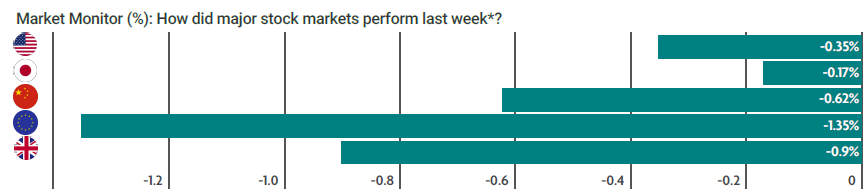
US: Equity markets end volatile week modestly lower
Major US equity markets ended a volatile and shortened week lower. Equities posted their largest daily fall since October following President Trump announcing he would impose tariffs on European countries that oppose the U.S. acquiring Greenland. Sentiment improved later in the week after a public shift in tone from President Trump, allowing markets to recover part of their losses. Economic data showed stronger than expected growth in the third quarter, supported by exports and business investment, with GDP growth revised up to 4.4% on an annualised basis (up from 3.8%).
The BEA also released its November core personal consumption expenditures (PCE) price index - the Federal Reserve’s preferred inflation gauge - which rose 0.2% from the prior month, in line with October’s reading. On a year-over-year basis, the index rose 2.8%, remaining well ahead of the Fed’s long-term inflation target of 2%. Meanwhile, labour market data pointed to continued resilience with low levels of jobless claims. Consumer sentiment improved from December but remained well below levels seen a year earlier.
Japan: Domestic political uncertainty weighs on markets
Japanese equities declined over the week as political developments unsettled investors. The announcement of an early election and proposals for a temporary cut to food consumption taxes raised concerns about fiscal discipline. Market participants questioned how lost government revenue would be replaced under the proposed policy. The central bank kept its policy stance unchanged and reiterated that future adjustments would depend on economic conditions. Updated forecasts pointed to stronger growth and higher inflation over the medium term. Overall sentiment remained cautious amid political and policy uncertainty.
China: China meets growth target in 2025 but appears to be slowing
Chinese equity markets were mixed as new data highlighted uneven economic conditions. Official figures showed that growth slowed in the fourth quarter to 4.5%, while full year expansion of 5% met the government’s target for a third consecutive year. Industrial output improved late in the year, supported by external demand, but consumer activity remained subdued. Fixed asset investment declined over the year, underscoring weak domestic confidence. Retail sales growth lagged expectations, marking one of the slowest readings since reopening. Analysts warned that sustaining current growth may be difficult as global protectionism increases and base effects turn less favourable.
Europe: Heightened geopolitical and trade uncertainty sees equities under pressure
European equities declined amid renewed geopolitical and trade uncertainty, with losses seen across major regional markets. France’s CAC 40 Index weakened 1.40%, Germany’s DAX lost 1.57%, and Italy’s FTSE MIB dropped 2.11%. Business surveys indicated that eurozone activity continued to expand modestly in January, supported by improving new orders and rising confidence. Optimism among businesses reached its highest level in nearly two years despite ongoing external risks. Political developments also weighed on sentiment, including delays surrounding the EU trade agreement with Mercosur. Overall, the region showed cautious economic progress alongside heightened uncertainty.
UK: UK labour market continues to soften
The UK labour market continued to soften, with unemployment remaining at a multi-year high and job losses concentrated in consumer facing sectors. Wage growth slowed further, including in the private sector, easing some pressure on businesses. Consumer activity showed tentative improvement as retail sales volumes rose in December after two weak months. Inflation accelerated unexpectedly, driven by higher travel and tobacco costs, though policymakers still expect price growth to slow to 2% in April/May. Business surveys signalled improved momentum entering the new year. The mixed data highlighted a fragile but stabilising economic backdrop.

The document is for informational purposes only and is not investment advice. We recommend you discuss any investment decisions with your financial adviser. Omnis is unable to provide investment advice. Every effort is made to ensure the accuracy of the information, but no assurance or warranties are given. Past performance should not be considered as a guide to future performance.


Comments